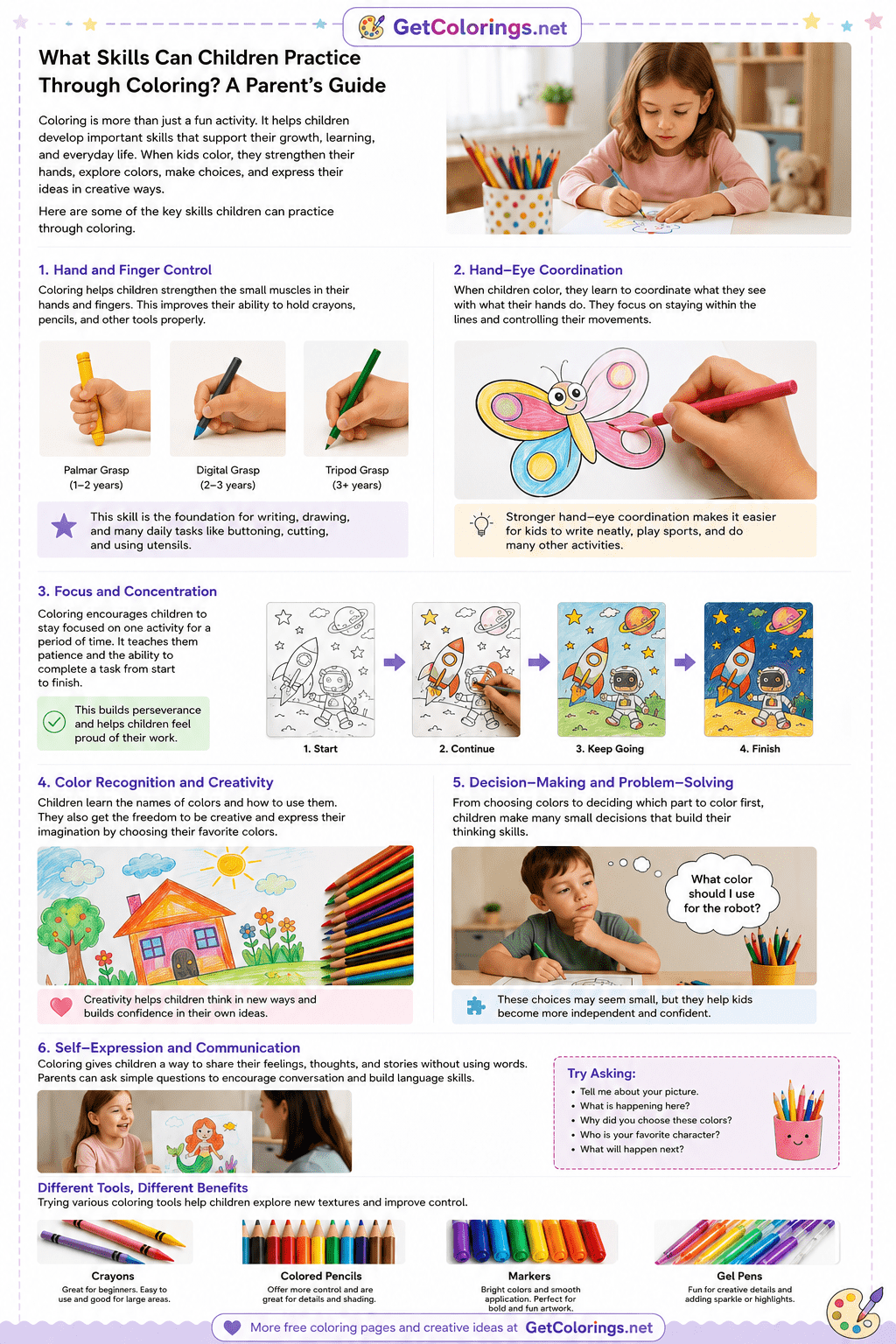
What Skills Can Children Practice Through Coloring? A Parent’s Guide
A coloring page may seem like a simple activity. A child chooses a crayon, colors a picture, and moves on.
Often, much more happens during those quiet minutes.
While coloring, children make choices, control hand movements, notice shapes, experiment with colors, and decide when their picture is complete. They may also talk about the image, invent a story, or explain why they chose green for the sky rather than blue.
Coloring should not be treated as a test or formal lesson. It is most useful when children explore freely without worrying about a perfect picture. Parents can also see that this familiar activity offers many opportunities to practice everyday skills.
This guide explains what children may practice through coloring and how parents can support the activity without creating unnecessary pressure.
1. Hand and Finger Control
One of the most noticeable parts of coloring is the physical movement involved.
To make marks on paper, a child must hold a crayon, move it in a chosen direction, adjust the pressure, and stop or change direction when needed. These movements require coordination between the fingers, hand, and wrist.
Younger children often begin by holding a crayon with their whole fist. Their marks may be large, fast, and uncontrolled. As they gain experience, they may gradually use their fingers more and make shorter, more deliberate movements.
Coloring can give children opportunities to practice:

- Gripping a crayon or colored pencil
- Moving the hand across the page
- Changing direction
- Using light or firm pressure
- Making short and long strokes
- Working within large or small spaces
- Switching tools between hands
The goal is not to force a specific pencil grip too early. Young children need time to explore different ways to hold drawing tools.
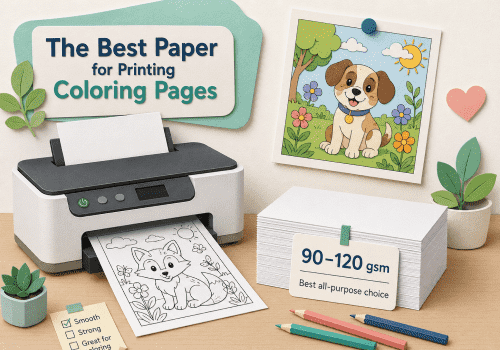
Large crayons and thick pencils are often easier for small hands. Older children may prefer standard colored pencils or fine-tip markers when working on detailed pictures.
Related guide: How to Choose the Right Coloring Pages for Your Child’s Age.
2. Hand-Eye Coordination
Coloring requires children to look at the page while controlling where their hand moves.
For example, a child may look at the outline of a flower, notice the edge of a petal, and try to guide the crayon through that space. The eyes provide information about the shape, while the hand changes speed or direction.
This process is known as hand-eye coordination.
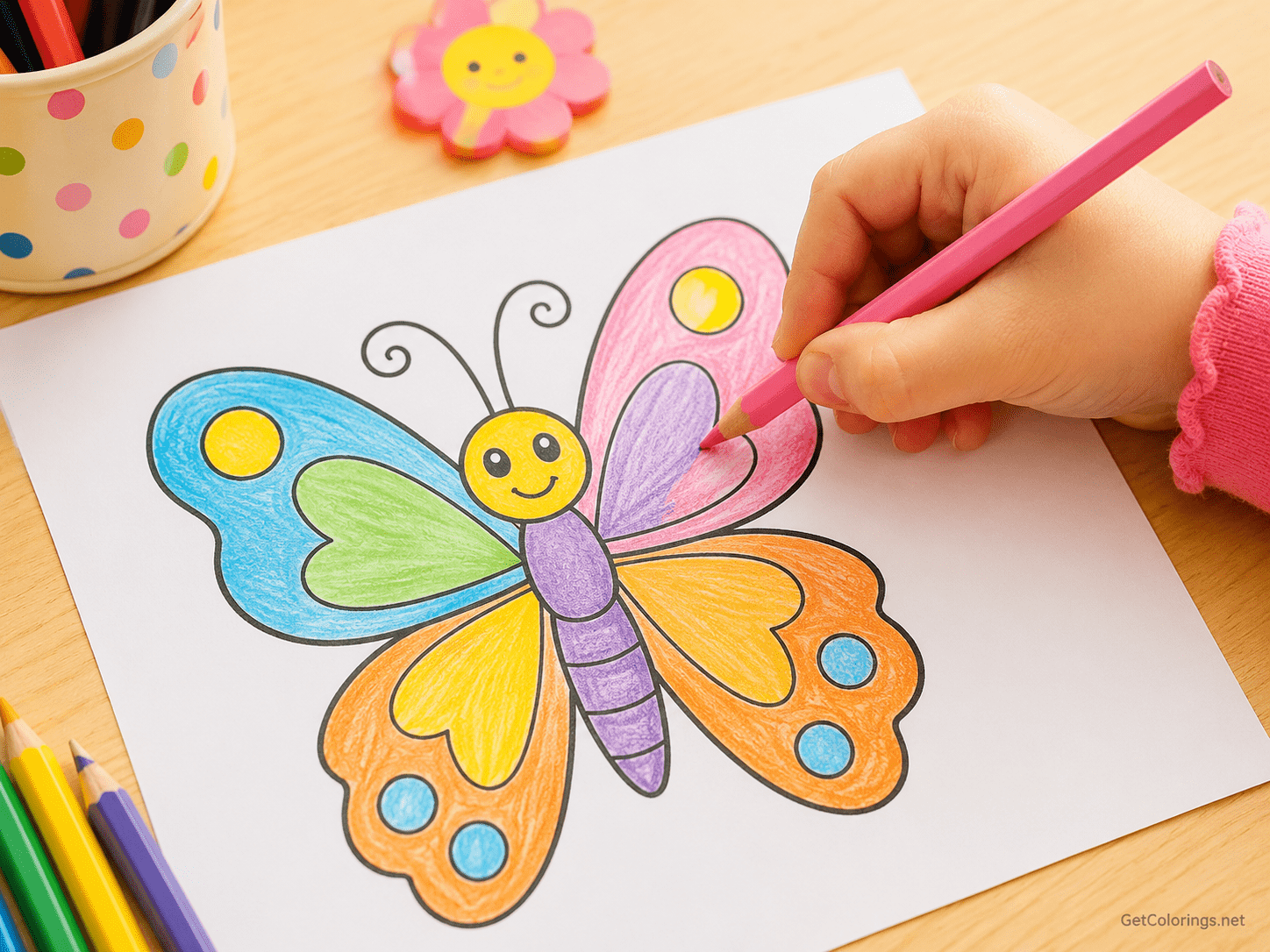
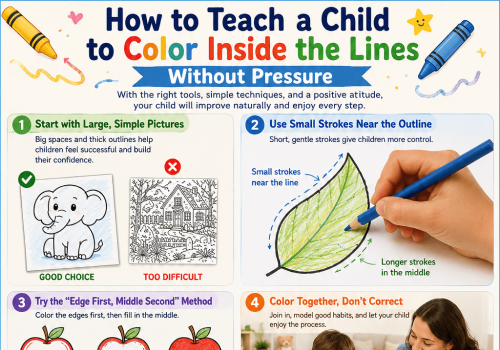
Young children may initially color across the entire picture without following outlines. That is normal. With experience, some make more intentional movements and pay closer attention to parts of the image.
Parents do not need to repeatedly say, “Stay inside the lines.” Using crayons, pencils, paper, building blocks, puzzles, and other hands-on materials gives children many chances to coordinate their vision with hand movements.
3. Visual Attention
A coloring page asks a child to look carefully.
Even a simple picture contains visual information. Children may notice:
- Where one object begins and another ends
- Which areas are large or small
- Whether a line is straight, curved, or broken
- Which details are part of the background
- Whether two shapes are similar
- Which sections have already been colored
A child coloring an animal may notice its ears, tail, paws, spots, and facial features. A child working on a vehicle page may notice the wheels, windows, lights, and doors.
This kind of observation can help children practice paying attention to visual details.
It is not necessary to turn every picture into a lesson. Parents can ask occasional questions like:
- “What do you notice in this picture?”
- “Which part do you want to color first?”
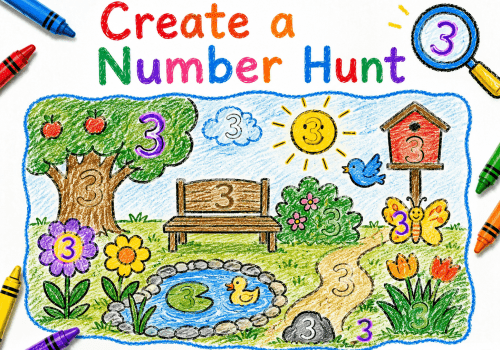
- “Can you find all the stars?”
- “Which area is the smallest?”
Questions should feel like conversation, not an examination.
4. Color Recognition
Coloring gives children a natural reason to notice and name colors.

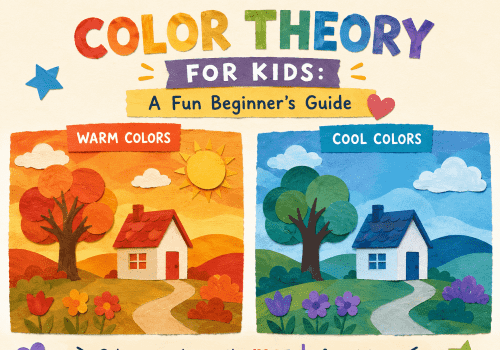
A younger child may learn to identify common colors such as red, blue, yellow, green, orange, purple, black, and brown. An older child may begin noticing lighter and darker shades or comparing similar colors.
Parents can introduce color words during the activity:
- “You chose a light blue.”
- “That green looks darker than this one.”
- “What color would you like for the leaves?”
- “You mixed red and yellow in the same picture.”
Children do not always need to use realistic colors. A pink tree, orange ocean, or purple dog is not a mistake. Unusual choices are part of creativity.
When the goal is color recognition, parents can gently name colors. When the goal is free expression, children should choose whatever they want.
5. Understanding Shapes, Lines, and Space
Coloring pages are made from shapes and lines, even when the picture shows a familiar object.
A house may contain squares, rectangles, and triangles. A flower may include circles, curved petals, and long stems. A robot may be built from many geometric sections.
While coloring, children may begin to notice:
- Circles, squares, triangles, and rectangles
- Curved and straight lines
- Large and small spaces
- Inside and outside areas
- Patterns and repeated shapes
- Foreground and background objects
Parents can point these out naturally during coloring. For example say:
- “The roof looks like a triangle.”
- “This wheel is a circle.”
- “There are three small windows.”
- “The path goes behind the tree.”
These simple observations make the activity more interesting without feeling like formal schoolwork.
6. Decision-Making
A blank coloring page contains many small decisions.
A child may decide:
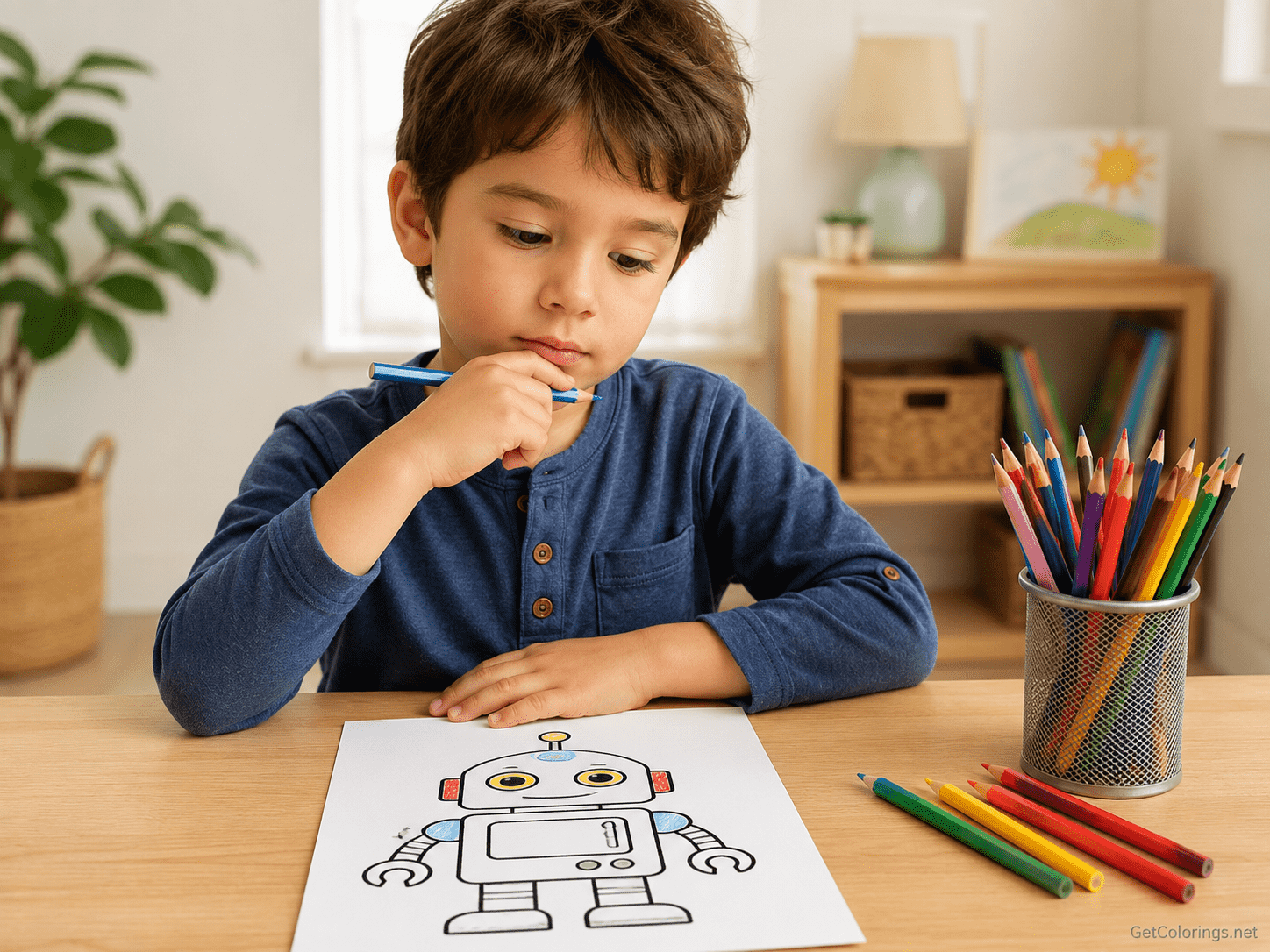
- Which page to choose
- Which tool to use
- Which color to begin with
- Which part to color first
- Whether to follow realistic colors
- Whether to add extra drawings
- When the picture is finished
Adults may see these as minor choices, but they give children a chance to make decisions independently in a safe environment.
Parents can support this by offering a limited number of options. Instead of a folder with 50 pictures, offer 2 or 3 pages and ask the child to select one.
The same approach works with art supplies. Too many choices may overwhelm younger children. A small set of crayons is enough.
Avoid taking over the activity. When an adult chooses every color and gives instructions for every section, the child has fewer chances to decide.
7. Planning and Completing a Task
Some children begin coloring immediately. Others pause and think about what they want to do first.
As children become more experienced, they may create a simple plan:
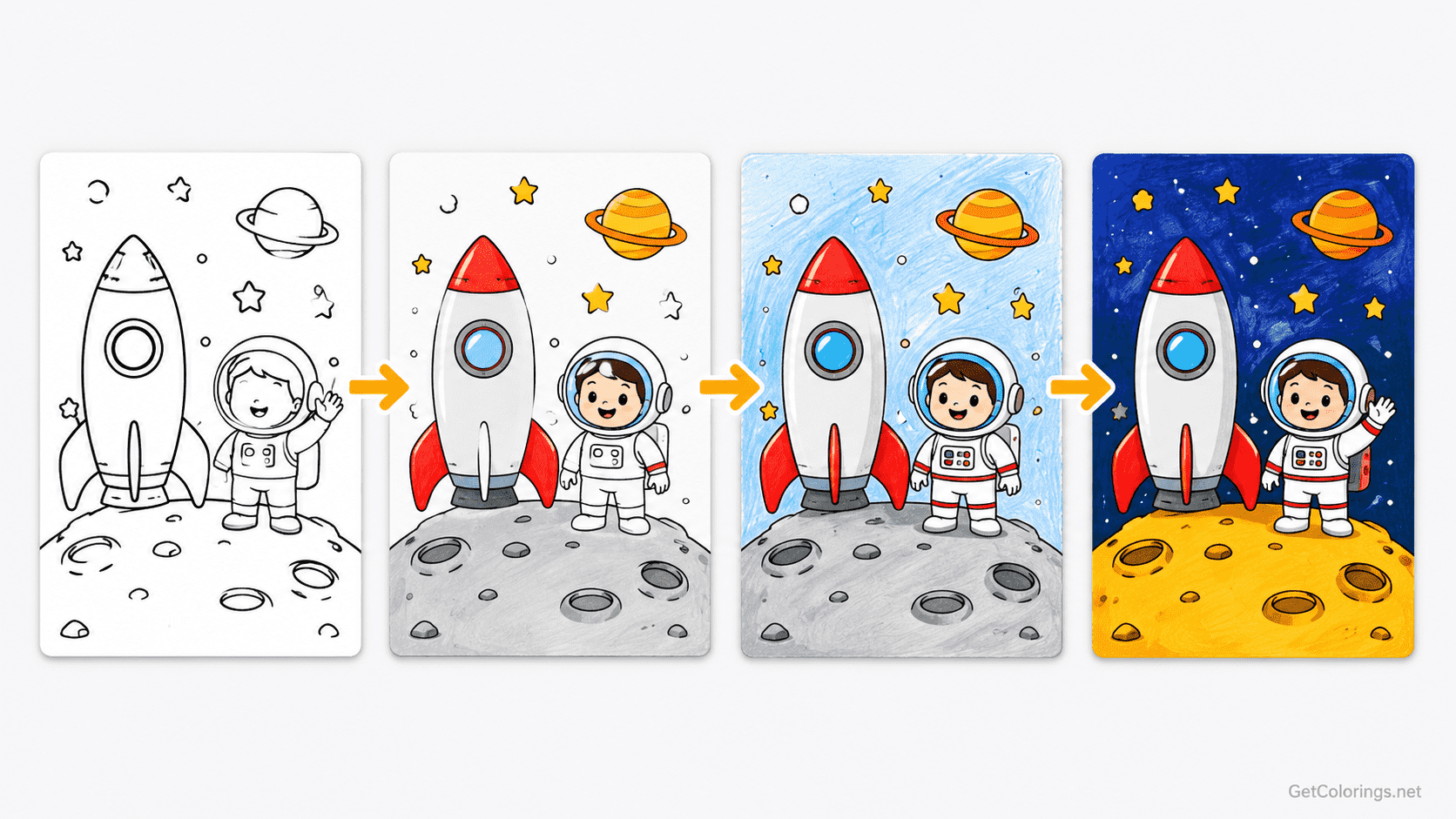
- Color the main object.
- Add colors to the smaller details.
- Finish the background.
- Add a name or extra drawing.
- Show the picture to someone.
Completing a coloring page can help children practice following a task from start to finish. However, finishing every page should not be required.
A child may lose interest, become tired, or decide to continue another day. That is fine. The activity is valuable even if the page is unfinished.
Parents can help by choosing a picture with an appropriate level of detail. A page that is too complicated may take much longer than the child expects.
Related guide: How to Choose the Right Coloring Pages for Your Child’s Age.
8. Patience and Persistence
Coloring often involves repetition. A child may fill one section with many small strokes before moving to the next.
For older children, a detailed page may require time and patience. They may need to sharpen a pencil, fix an area they dislike, choose another shade, or return to the page later.
These experiences can give children opportunities to practice persistence.
The key is to keep expectations reasonable. A three-year-old is unlikely to sit quietly with a complicated coloring page for long. A ten-year-old may enjoy working on an intricate design over several sessions.
When a child becomes frustrated, parents can say:
- “You can take a break.”
- “Would you like a larger crayon?”
- “We can choose an easier page.”
- “You do not have to finish it today.”
- “Would you like me to color next to you?”
Patience grows more naturally when children feel supported rather than pressured.
9. Focus and Quiet Engagement
Coloring can be a calm activity because it gives children one clear thing to do.
Some children enjoy coloring during:
- A quiet afternoon at home
- Travel
- Restaurant waiting times
- Rainy days
- Classroom breaks
- Screen-free time
- The period before bedtime
- Family activity time
The amount of time a child remains focused will vary by age, interest, energy level, and personality. Some children color for five minutes, while others stay engaged much longer.
Parents should avoid comparing siblings or classmates. A child who prefers active play is not doing anything wrong.
To support focus, create a simple environment:
- Use a comfortable table
- Reduce background noise when possible
- Provide a small selection of tools
- Choose a subject the child likes
- Avoid interrupting with constant corrections
- Keep the page appropriate for the child’s ability
Interest is often the strongest reason a child stays with an activity.
10. Creativity and Imagination
A coloring page already includes an image, but the child can still make it personal in many ways.
Children can:
- Create an unusual color combination
- Add weather to the background
- Draw extra characters
- Add clothes or accessories
- Turn daytime into nighttime
- Create patterns inside empty spaces
- Invent a setting for the picture
- Combine several pages into a story
A simple dinosaur page may become a scene on another planet. A house may belong to a magician. A fish may live in an underwater city.
Parents can encourage imagination by asking open questions:
- “Where does this animal live?”
- “What is happening in the picture?”
- “What could you add to the background?”
- “Does this character have a name?”
- “What might happen next?”
There is no need to ask all of these questions during every activity. Sometimes children want to color quietly, and that should be respected, too.
11. Storytelling and Language
Pictures can provide an easy starting point for conversation.
A child may describe the image, explain color choices, name objects, or invent a story about the characters. These conversations give children opportunities to practice using words and organizing ideas.
For example, after coloring a farm page, a parent might ask:
- “Which animal is your favorite?”
- “What do you think the farmer is doing?”
- “What sound does this animal make?”
- “What might happen after the sun goes down?”
Older children can write a short title, sentence, or story below the completed picture.
The aim is not to correct every grammar mistake. The main purpose is to help the child connect visual ideas with spoken or written language.
12. Self-Expression
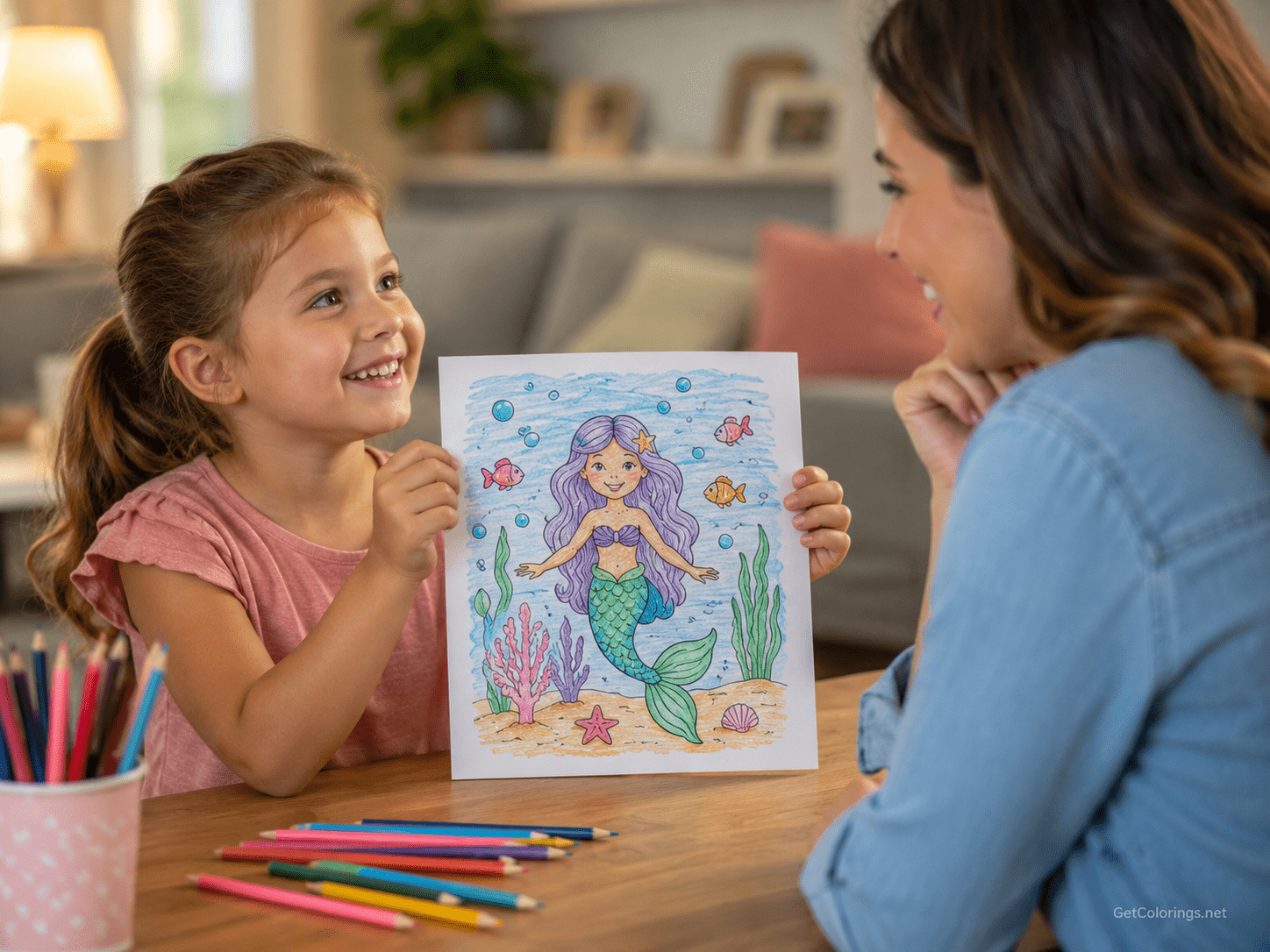
Children may use color differently depending on their mood, preferences, and imagination.
One child may use bright colors across the entire page. Another may choose only two colors. Some children prefer neat patterns, while others enjoy energetic scribbling.
A finished page can reveal what the child found interesting, but adults should be careful not to make strong assumptions based solely on color choices. A child using black does not automatically mean something is wrong. Black may simply be the easiest crayon to find or the child’s favorite color that day.
Parents can support self-expression by responding with curiosity rather than judgment.
Instead of saying:
- “Why did you make it the wrong color?”
- “You should have used green.”
- “That does not look realistic.”
Try saying:
- “Tell me about your picture.”
- “I noticed you used several bright colors.”
- “Which part do you like best?”
- “How did you choose these colors?”
These responses keep the conversation open.
13. Confidence and Independence
Children often feel proud when they create something on their own.
They may carry the picture around the house, place it on a wall, give it to a family member, or ask an adult to take a photo. This pride can come from making choices and completing an activity independently.
Parents can support confidence by praising specific effort rather than giving only general compliments.
Instead of saying only, “Good job,” try:
- “You spent a lot of time on those small details.”
- “You chose those colors by yourself.”
- “I can see that you added your own background.”
- “You kept working even when that part was difficult.”
- “You made this page look very different from the original.”
Specific feedback shows the child that the adult noticed the process, not just the final result.
At the same time, parents do not need to praise every single mark. A simple, interested response is often enough.
14. Following Simple Instructions
Some coloring activities include basic directions, such as:
- Color all the circles blue.
- Find and color five stars.
- Use warm colors for the background.
- Color by number.
- Complete the repeating pattern.
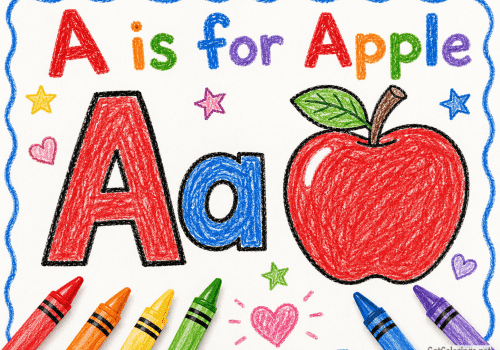
- Match the letter with the correct picture.
These pages can give children opportunities to listen, remember, and follow simple instructions.
However, instructional coloring pages should be age-appropriate. Too many rules may make the activity frustrating.
It is also helpful to balance guided pages with free coloring. Children should have opportunities to follow instructions and make their own choices.
15. Practicing With Different Art Tools
Changing the coloring material can create a new experience, even when using the same page.
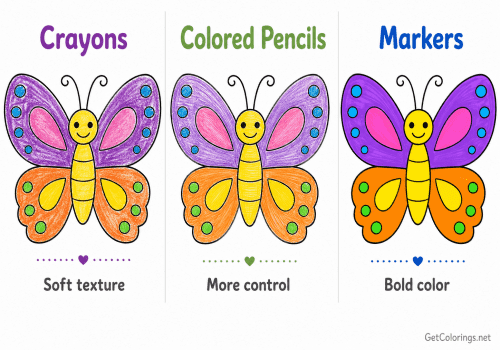
Crayons
Crayons are easy to use and work well for large spaces. Thick crayons can be comfortable for younger children.
Colored pencils
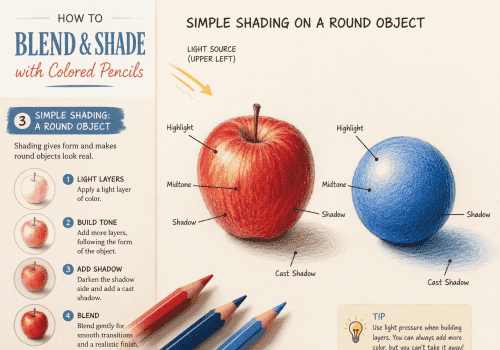
Colored pencils offer greater control and are useful for detailed drawings, blending, and shading.
Markers
Markers create strong colors and require less pressure. They can bleed through thin paper, so place an extra sheet underneath.
Chalk or pastel sticks
These materials create softer textures but can be messy. They are better suited to children who can use them safely.
Watercolor pencils
Older children may enjoy coloring first and then adding a small amount of water with a brush. Use suitable paper and adult supervision.
Trying different materials can help children notice pressure, texture, line thickness, and color intensity.
What Parents Should Expect at Different Ages
Every child develops differently, so age ranges should be treated as general guidance rather than strict rules.
Toddlers
Toddlers may:
- Scribble across the page
- Hold crayons with their whole hand
- Use one color for everything
- Switch activities quickly
- Ignore the picture’s outlines
This is a normal early stage of exploration.
Preschool children
Preschoolers may:
- Recognize familiar pictures
- Use several colors
- Try to fill separate areas
- Begin following large outlines
- Talk about what they are coloring
Their control may still vary greatly from one day to another.
Early school-age children
Children in early primary school may:
- Work with smaller spaces
- Follow more detailed outlines
- Choose colors more intentionally
- Complete simple coloring instructions
- Add backgrounds and extra objects
Older children
Older children may:
- Prefer realistic or detailed designs
- Experiment with shading
- Blend colors
- Use patterns and textures
- Work on one page over several sessions
Some older children still prefer very simple pages, and that is perfectly fine.
How Parents Can Make Coloring More Useful
Parents do not need to teach a formal lesson every time a child picks up a crayon. A few simple choices can make the activity more enjoyable.
Let the child choose
Offer a small selection of pages and allow the child to decide.
Match the difficulty
Choose large, simple spaces for younger children and more detailed pages for children who want a challenge.
Provide suitable materials
Use washable crayons for younger children and sharper pencils or fine markers for older children.
Sit nearby without controlling
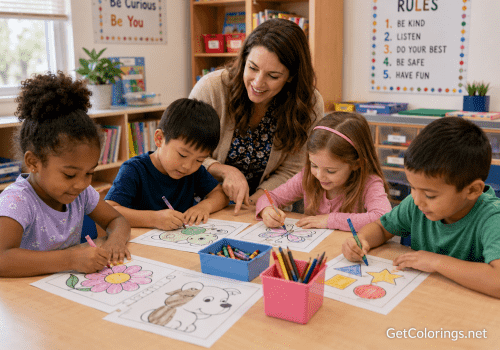
Coloring together can be enjoyable, but avoid completing the child’s picture unless the child asks you to.
Allow unusual colors
Creative color choices are part of the activity.
Display selected artwork
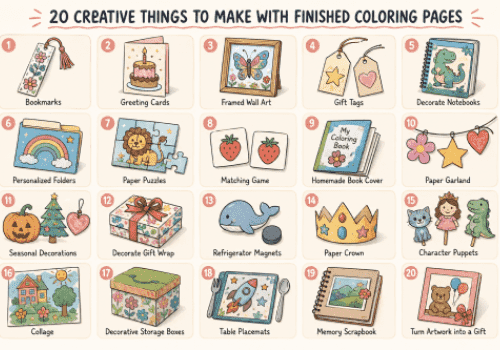
Place a favorite picture on the refrigerator, wall, or in a simple folder.
Keep sessions optional
Children should not be forced to color for a specific amount of time.
Talk about the process
Ask what the child enjoyed rather than judging whether the picture looks correct.
Common Mistakes to Avoid
Expecting children to stay inside the lines
This skill develops gradually. Constant correction can make the activity stressful.
Choosing pages that are too difficult
Tiny sections and crowded backgrounds can discourage younger children.
Giving too many choices
A small selection is often easier than hundreds of options.
Comparing children
Siblings of similar ages may color in completely different ways.
Taking over the picture
Adults may be tempted to fix an area or show the “right” way. This can reduce independence.
Treating every page as schoolwork
Children also need creative activities without educational goals or instructions.
Focusing only on the finished picture
The choices, movements, conversation, and enjoyment during the activity are just as important.
Frequently Asked Questions
Does coloring help children develop fine motor skills?
Coloring gives children opportunities to practice controlling crayons or pencils with their hands and fingers. It should be one of many hands-on activities, alongside play with blocks, clay, puzzles, cutting, drawing, and everyday objects.
Should I correct my child for coloring outside the lines?
Usually, no. Younger children are still learning to control their movements. Encourage participation and enjoyment rather than perfect accuracy.
Is coloring educational?
It can include learning opportunities involving colors, shapes, numbers, letters, vocabulary, and instructions. However, free coloring without a formal lesson can also be valuable.
How long should a child spend coloring?
There is no required amount of time. Some children may color for a few minutes, while others may stay interested much longer. Follow the child’s attention and comfort level.
What should I do if my child does not enjoy coloring?
Do not force the activity. Try different subjects, larger pictures, new materials, drawing on a whiteboard, painting, stickers, clay, or other creative activities.
Are color-by-number pages good for children?
They can help children practice number recognition, color matching, and following instructions. They should be balanced with free-choice activities.
Should parents color with their children?
Yes, when the child enjoys it. Coloring together can encourage conversation and provide a calm shared activity. Let the child control their own page.
Final Thoughts
Coloring is not a magic activity, and it does not need to be presented as one.
Its value comes from the many small things children do while they color: holding a tool, moving their hands, observing a picture, choosing colors, making decisions, discussing ideas, and deciding when they are finished.
The best coloring experience is usually simple. Choose a page that matches the child’s interests and current abilities. Provide suitable materials. Then give the child enough freedom to explore.
The picture does not need to be perfect. A page filled with uneven lines, surprising colors, and an invented story may be far more meaningful to a child than a perfectly completed design.