Color Theory for Kids: A Fun Beginner’s Guide
Why does a sunset feel warm, while an underwater picture feels cool? Why do yellow and purple look so bright beside each other? And what happens when blue and yellow are used in the same picture?
Color theory might sound like something you learn in art school, but kids are already exploring it every time they pick a crayon, mix colors, or decide how to color the sky.
The best way to teach color theory isn’t with long explanations. Let kids see for themselves what happens when they use different colors.
All you need to get started are some printable pages and a few crayons, colored pencils, or markers.
Meet the Three Color Families
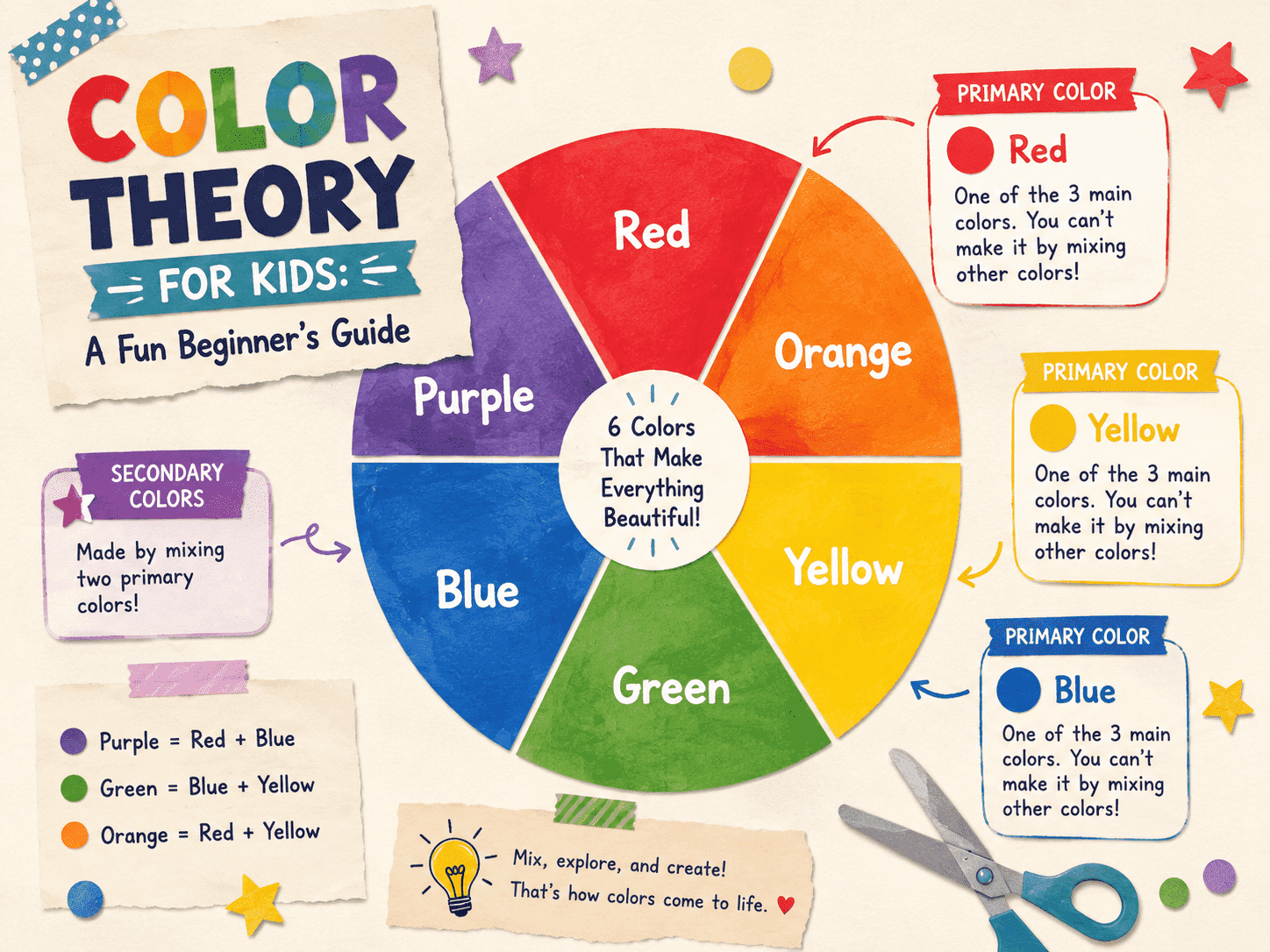
Start with the three primary colors: red, yellow, and blue.
They’re called primary colors because they’re the starting point for many other colors. Ask your child to color three big circles: one red, one yellow, and one blue.
Next, introduce secondary colors.
When two primary colors are combined, they create a new color:
Red and yellow make orange.
Yellow and blue make green.
Blue and red make purple.
If you’re using paint, kids can mix the colors together. With crayons or colored pencils, they can layer one color over another and watch a new shade appear.
Colored pencils are especially useful for this experiment because the colors can be layered gradually. The techniques in How to Blend and Shade with Colored Pencils show how light pressure and repeated layers can create smoother results.
Don’t worry if the mixed color isn’t perfect. Different art supplies make different shades. A blue pencil over yellow might make a darker green than expected, and crayons can leave a more textured look.
What matters most is the discovery, not matching a color chart exactly.
A Simple Color-Wheel Experiment
A color wheel is simply a circle that shows how colors relate to one another.
You don’t need a fancy template. Just divide a circle into six big sections and put the colors in this order:
Red, orange, yellow, green, blue, and purple.
Have your child color the three primary sections first, then fill in the spaces between them with the secondary colors.
While coloring, ask simple questions:
“Which color sits between red and yellow?”
“Which two colors can make green?”
“Where would purple go?”
This helps kids see that colors are connected, not just random.
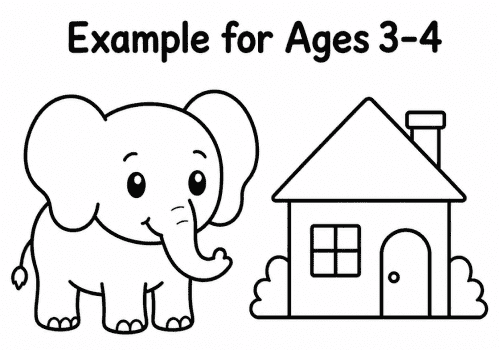
For younger kids, try a big wheel with thick outlines. Older kids might like dividing the wheel into more sections and adding lighter or darker versions of each color. The guide How to Choose the Right Coloring Pages for Your Child’s Age can help you pick the right design.
Warm Colors and Cool Colors
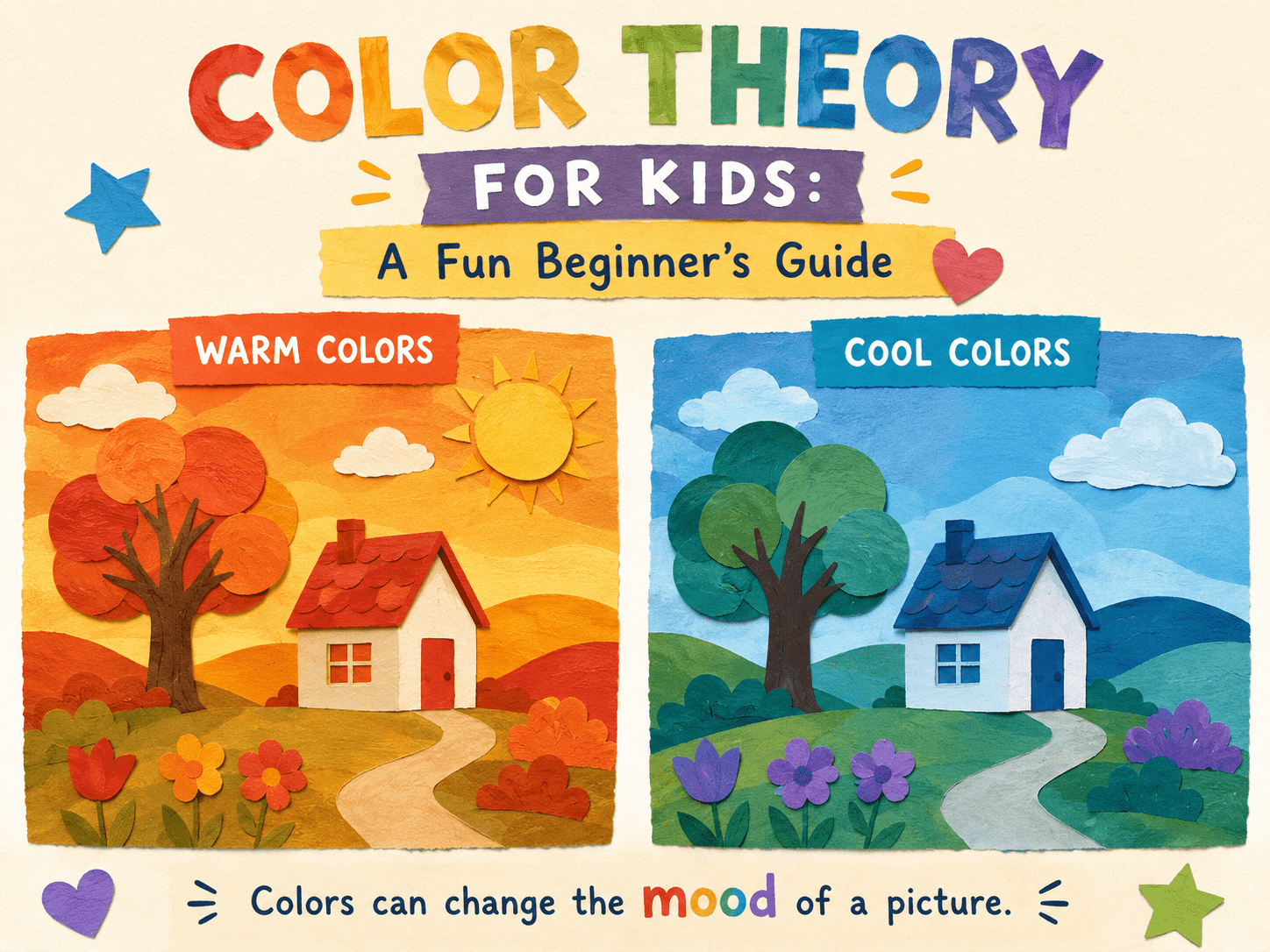
Once kids know the basic color wheel, you can introduce warm and cool colors.
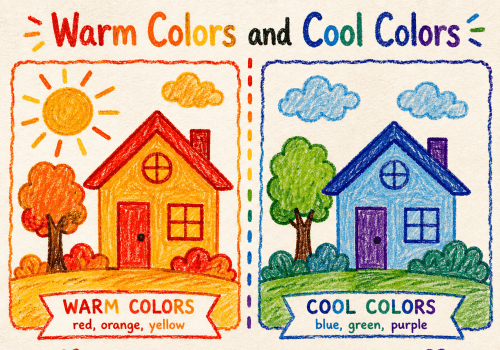
Warm colors include red, orange, and yellow. They often remind people of sunlight, fire, autumn leaves, and warm food.
Cool colors include blue, green, and purple. They may suggest water, shade, nighttime, snow, or a quiet forest.
Give your child two copies of the same simple coloring page.
Have them color the first version with mostly warm colors and the second with mostly cool colors.
A house painted orange with a yellow sky and red flowers may feel energetic and sunny. The same house in blue, green, and purple may feel calm, rainy, or magical.
There’s no one right feeling. Ask your child what each version makes them think of.
This activity shows how color can change a picture’s mood, even when the outlines stay the same.
Colors That Stand Out Together
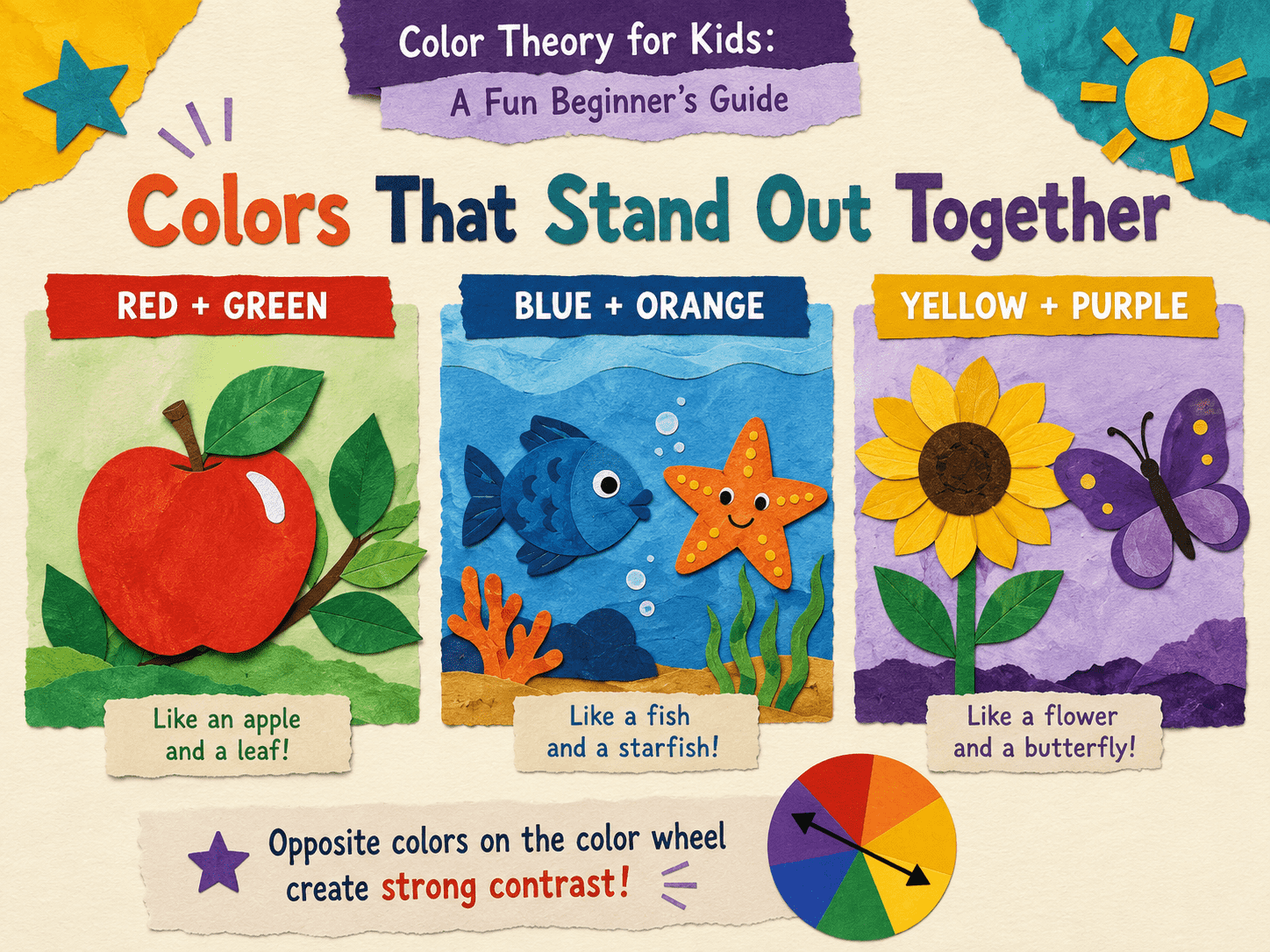
Some colors create strong contrast when placed side by side.
On a basic color wheel, colors directly opposite each other are called complementary colors. Common pairs include:
- Red and green
- Blue and orange
- Yellow and purple
These pairs often look brighter when you use them together.
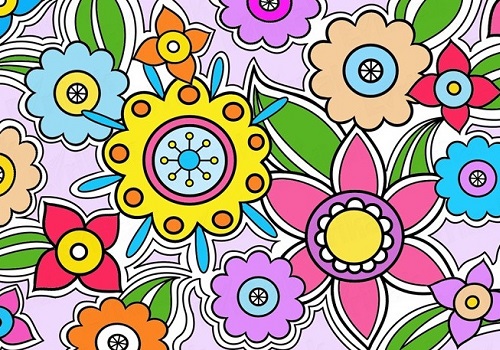
Ask your child to color three simple objects with these combinations. For example, a flower could have purple petals and a yellow center, a blue rocket might have orange flames, and a red apple can stand out against green leaves.
You don’t have to use complementary colors everywhere. Even a small contrasting detail can catch the eye.
For example, a mostly blue underwater scene can feel more interesting if you add one bright orange fish.
This trick is helpful when kids want one part of their picture to stand out.
Light, Dark, and Everything Between
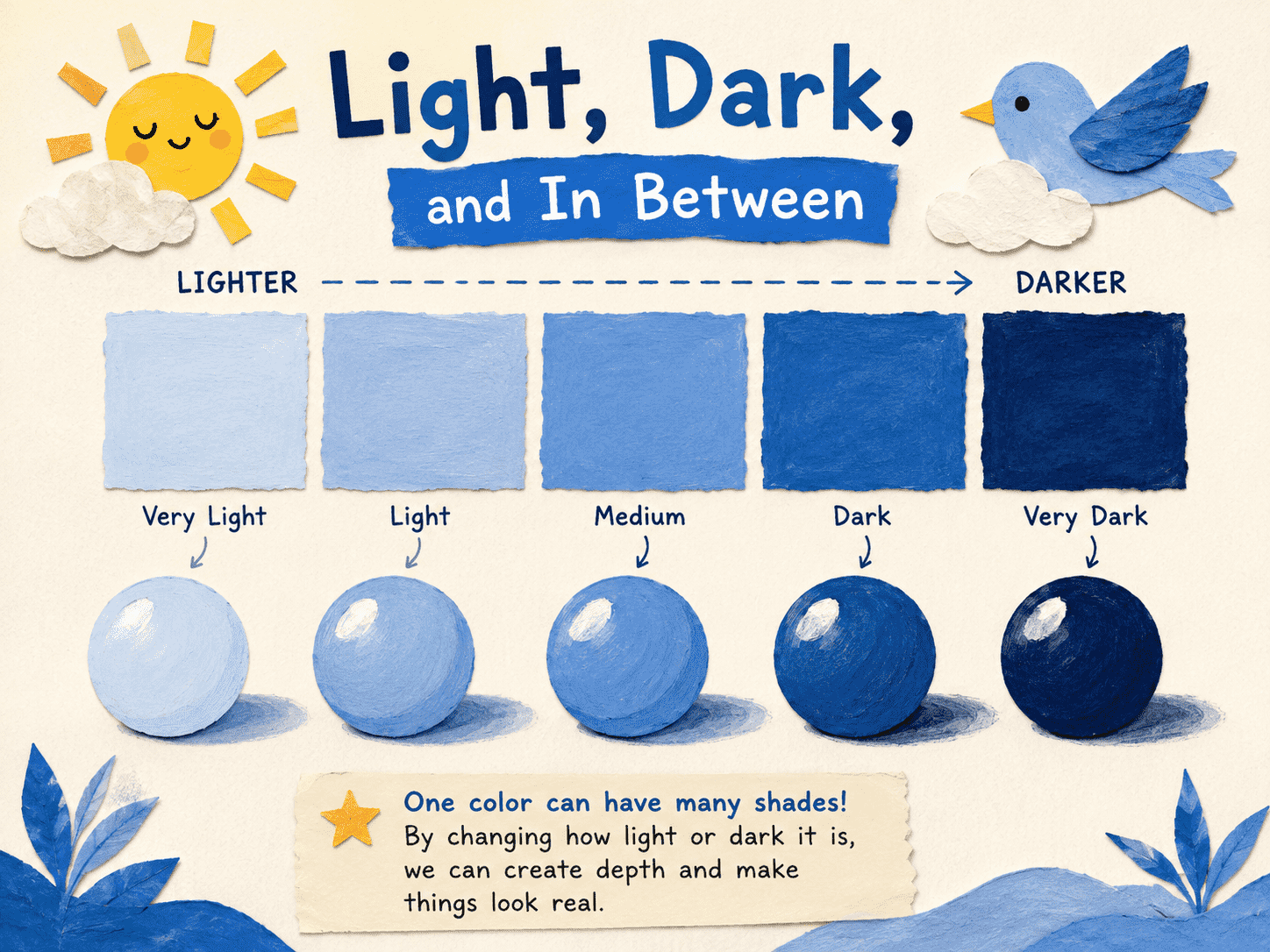
A color is not limited to one fixed appearance.
Blue can be pale, like the morning sky, or dark, like the ocean at night. Green can be bright and fresh or deep and shadowy.
Kids can make lighter or darker versions by pressing harder or softer with their pencils, layering colors, or adding nearby shades.
Draw five boxes in a row. Have your child use one pencil to color the first box very lightly, then make each box a bit darker than the last.
This creates a value scale.
Value just means how light or dark a color looks. Knowing about value helps kids make round objects, shadows, and backgrounds look more interesting.
A white area can be left as a highlight, while the opposite side of an object can be shaded more heavily.
If the child is using printed pages for this activity, slightly stronger paper often handles repeated pencil layers better than very thin sheets. See The Best Paper for Printing Coloring Pages at Home for practical paper recommendations.
Use Color to Tell a Story
Color theory becomes more memorable when it is connected to storytelling.
Give your child a simple scene and imagine different ways to color it.
What colors would you choose for a cheerful birthday party?
What colors would make a castle look mysterious?
How would the same forest look in summer, autumn, and winter?
A cheerful picture might use bright yellows, oranges, greens, and pinks. For a mysterious scene, try dark blue, purple, gray, and a few bright spots for contrast.
Kids don’t have to follow traditional color rules. A green sun or a purple tree can be a fun, creative choice.
Ask your child why they picked a certain color, instead of saying it’s unrealistic.
Questions like “What’s happening in this picture?” or “How do these colors make the scene feel?” help kids connect color with imagination and language.
These choices are part of the creativity and decision-making discussed in What Skills Can Children Practice Through Coloring? A Parent’s Guide.
Try a One-Color Challenge
A fun color exercise is to make a whole picture using just one color family.
For example, pick blue and gather every blue tool you have: light blue, dark blue, turquoise, navy, and blue-violet.
Color the whole page using only those shades of blue.
This is called a monochromatic color scheme.
The result shows that a picture can still have variety even when it uses only one main color. Light areas, dark areas, textures, and patterns keep the design from looking flat.
The same activity can be repeated with green for a forest, orange for an autumn page, or purple for a fantasy scene.
Keep the Activity Playful
Kids don’t need to memorize technical words to enjoy color.
You can introduce words like primary, secondary, complementary, warm, cool, and value little by little. What matters most is giving kids chances to compare, mix, notice, and choose colors.
Try not to correct every unusual color choice. Color theory is a guide, not a set of strict rules.
A child might know that leaves are usually green but still decide to color them pink. That choice can be part of the story they’re telling.
Parents and teachers can make things easier by offering just a few colors at first. Too many choices can distract younger kids.
Crayons are useful for bold, simple experiments, colored pencils are good for layering and shading, and markers create strong contrast. Their differences are explained in Crayons vs. Colored Pencils vs. Markers.
Make a Color Book from Your Experiments
Save your child’s color wheel, warm-and-cool picture, complementary color examples, value scale, and one-color challenge.
Put these pages together to make a small, personal color book.
Add a cover with the child’s name and a title such as:
- My First Color Book
- Emma’s Color Experiments
- My Guide to Amazing Colors
The steps in Turn Your Ideas into a Personalized Coloring Book can be used to print, organize, and bind the finished pages.
Teachers can also use the same idea as a classroom project. Each student may complete one color experiment and explain what they discovered.
Final Thoughts
Kids don’t need to start learning color theory by memorizing terms.
It can begin with a simple question: “What happens when we put these colors together?”
When kids make a color wheel, compare warm and cool pictures, try complementary pairs, and play with light and dark shades, they start to see how color changes a picture.
The best lessons happen when children are allowed to test ideas, make unexpected choices, and discover their own favorite combinations.