A Complete Guide to Creating a Preschool Coloring Lesson
Preschool coloring lessons are most effective when they feel like creative play instead of a long list of instructions.
Young children do not need complicated art projects. They benefit from a clear idea, an easy-to-understand picture, comfortable coloring tools, and the freedom to make their own choices.
A well-planned coloring lesson can help children build vocabulary, practice listening, recognize colors, count, tell stories, and develop hand control, all in a short classroom activity.
You can adapt this plan for children ages three to five, and it takes about 25 to 30 minutes to complete.
Before the Children Arrive: Choose One Simple Goal
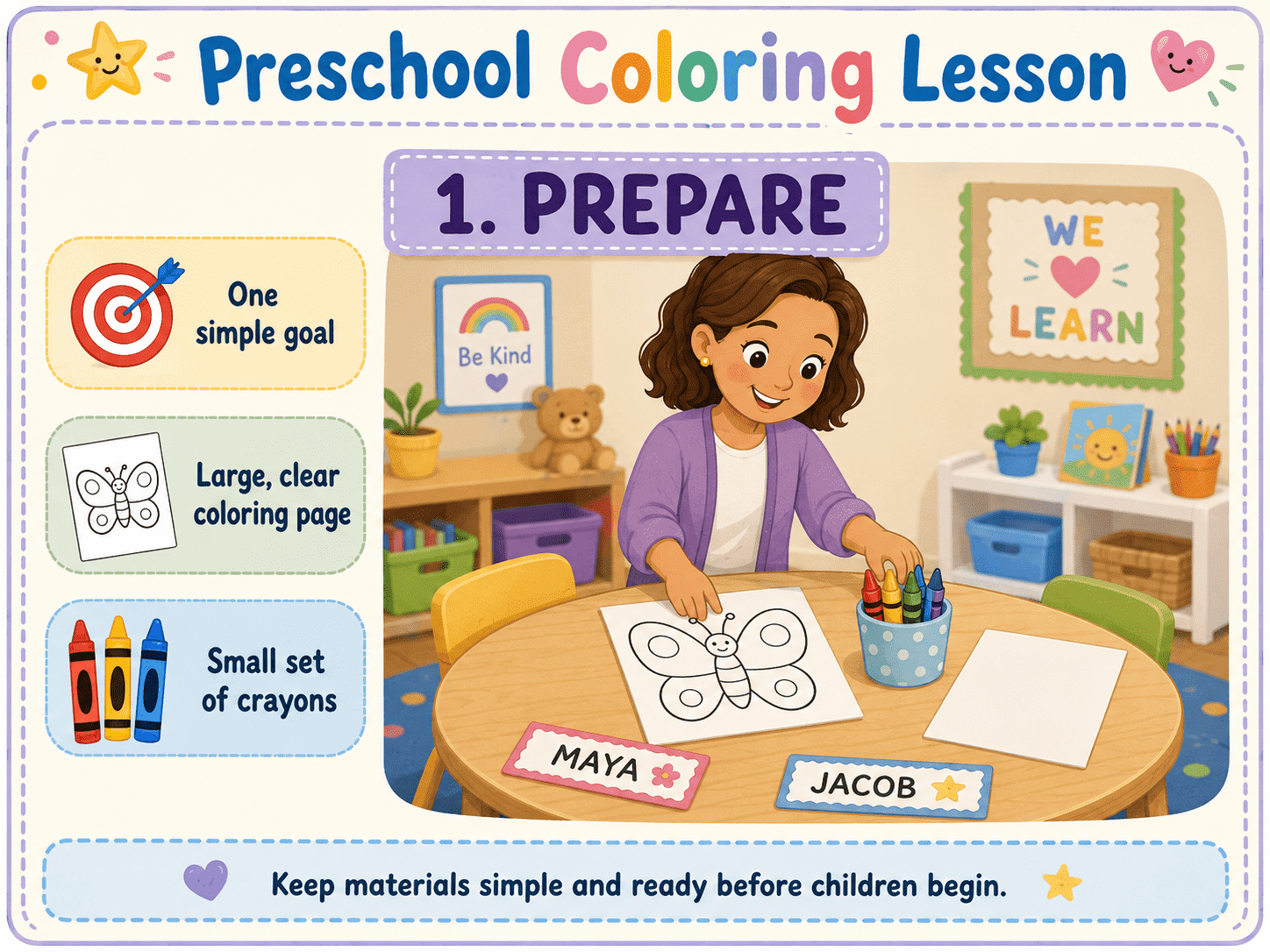
Begin by deciding what the lesson should help children practice.
Try not to teach colors, numbers, letters, shapes, animals, and pencil control all at the same time. Focusing on one clear goal helps keep the activity calm and focused.
For example, the lesson might focus on:
- Color recognition: identifying red, yellow, blue, and green
- Vocabulary: learning the names of farm animals
- Counting: coloring three flowers or five stars
- Letters: connecting the letter B with a butterfly
- Listening: following the two simple coloring directions
- Creativity: designing an imaginary animal
After you decide on the goal, pick a coloring page that fits with it.
A number lesson may use balloons or apples. A letter lesson could feature one large letter and a familiar matching object. A nature lesson might use a flower, a tree, a butterfly, or a simple garden scene.
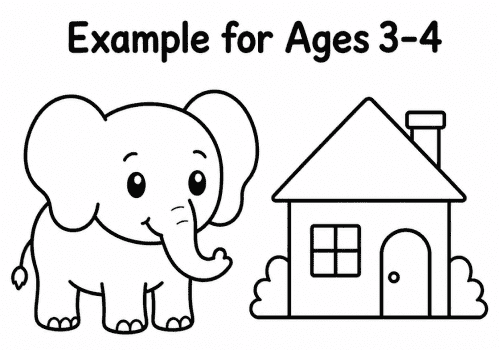
The page should have thick outlines, large open spaces, and very few distracting details. How to Choose the Right Coloring Pages for Your Child’s Age provides more guidance on matching picture complexity to a child’s ability.
Prepare a Small, Manageable Set of Materials
Preschoolers usually feel more confident when there are only a few supplies on the table.
For each child, prepare:
- One coloring page
- A small selection of crayons
- A name label or a pencil
- One spare sheet of paper
Six to eight crayons are usually enough. Having fewer choices makes it easier for children to decide and saves time looking through a big box.
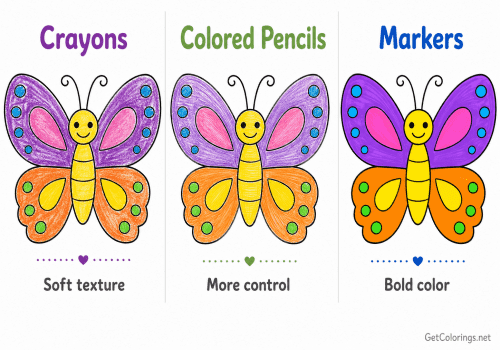
Thick crayons are usually best for preschoolers. They are easy to hold, do not need sharpening, and work well for coloring big areas. Crayons vs. Colored Pencils vs. Markers can help you choose the right materials for different activities.
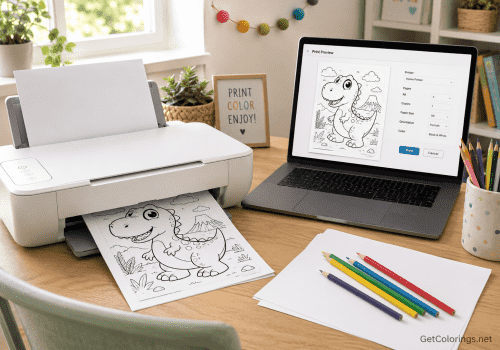
Print a test page before making copies for the whole class. Make sure the picture fills most of the paper, the outlines are dark, and nothing important is missing. For more tips, see How to Print Coloring Pages at Home.
Minute 0-5: Introduce the Picture Through Conversation
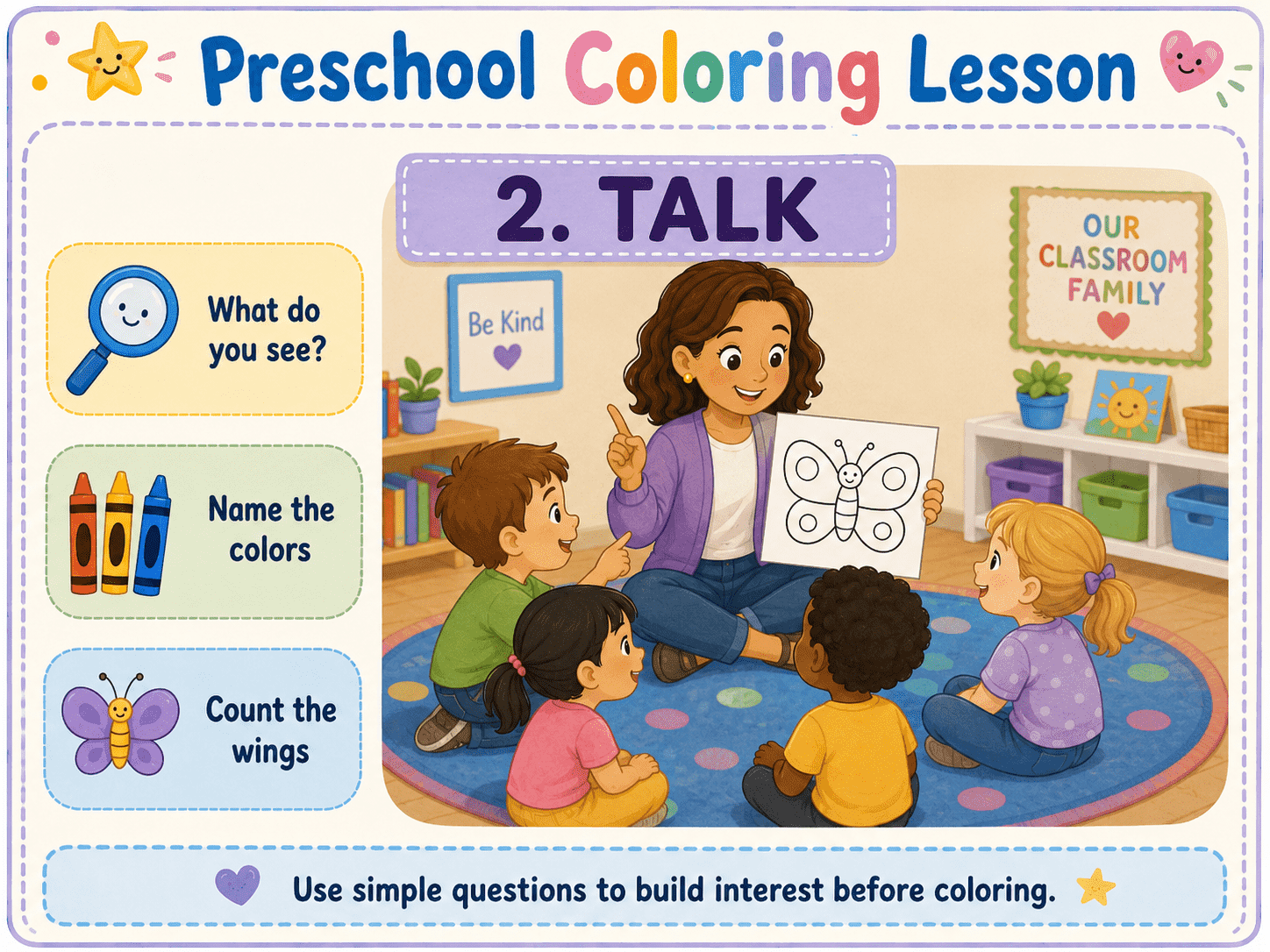
Do not hand out the crayons immediately.
First, show the page to the group and spend a few minutes talking about what they see.
For a butterfly page, you might ask:
“What animal is this?”
“How many wings can you see?”
“What colors have you seen on butterflies?”
“Where might a butterfly live?”
Ask questions that are simple for children to answer. This helps introduce the picture, build vocabulary, and spark their interest.
You do not need to correct every answer. If a child says a butterfly lives in a tree, garden, or even a magical castle, that is fine. Let the conversation include both real facts and imagination.
This short introduction also encourages children to look closely at the page before they start coloring.
Minute 5-8: Demonstrate One Useful Technique
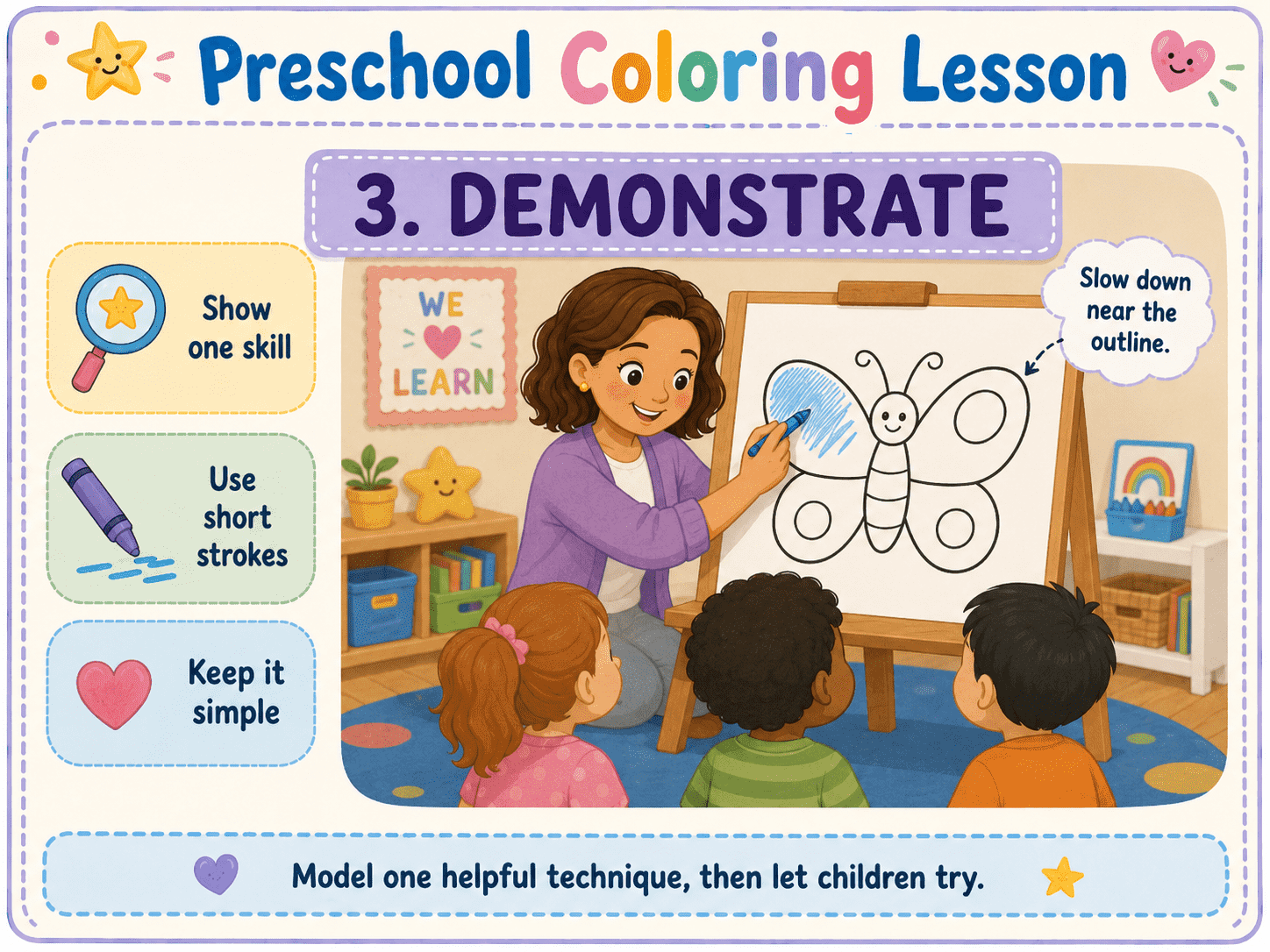
A preschool coloring lesson only needs one brief demonstration.
Place your own page where everyone can see it. Model the skill connected to the lesson.
You might demonstrate how to:
- Choose one color at a time
- Make short strokes
- Color a large section
- Slow down near an outline
- Use light pressure
- Change colors between different objects
Keep your demonstration relaxed and easygoing.
Say something such as:
“I am using small movements near the wing. Some color may go outside the line, and that is okay.”
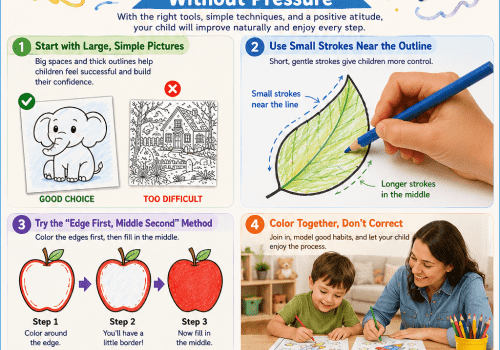
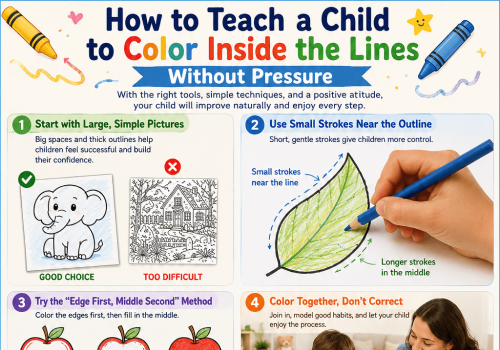
This helps children learn control without focusing too much on neatness. You can find more helpful techniques in How to Teach a Child to Color Inside the Lines Without Pressure.
Do not finish a perfect example in front of the class. Children might think their page has to look just like yours. Show enough to explain the technique, then stop.
Minute 8-20: Let the Children Color
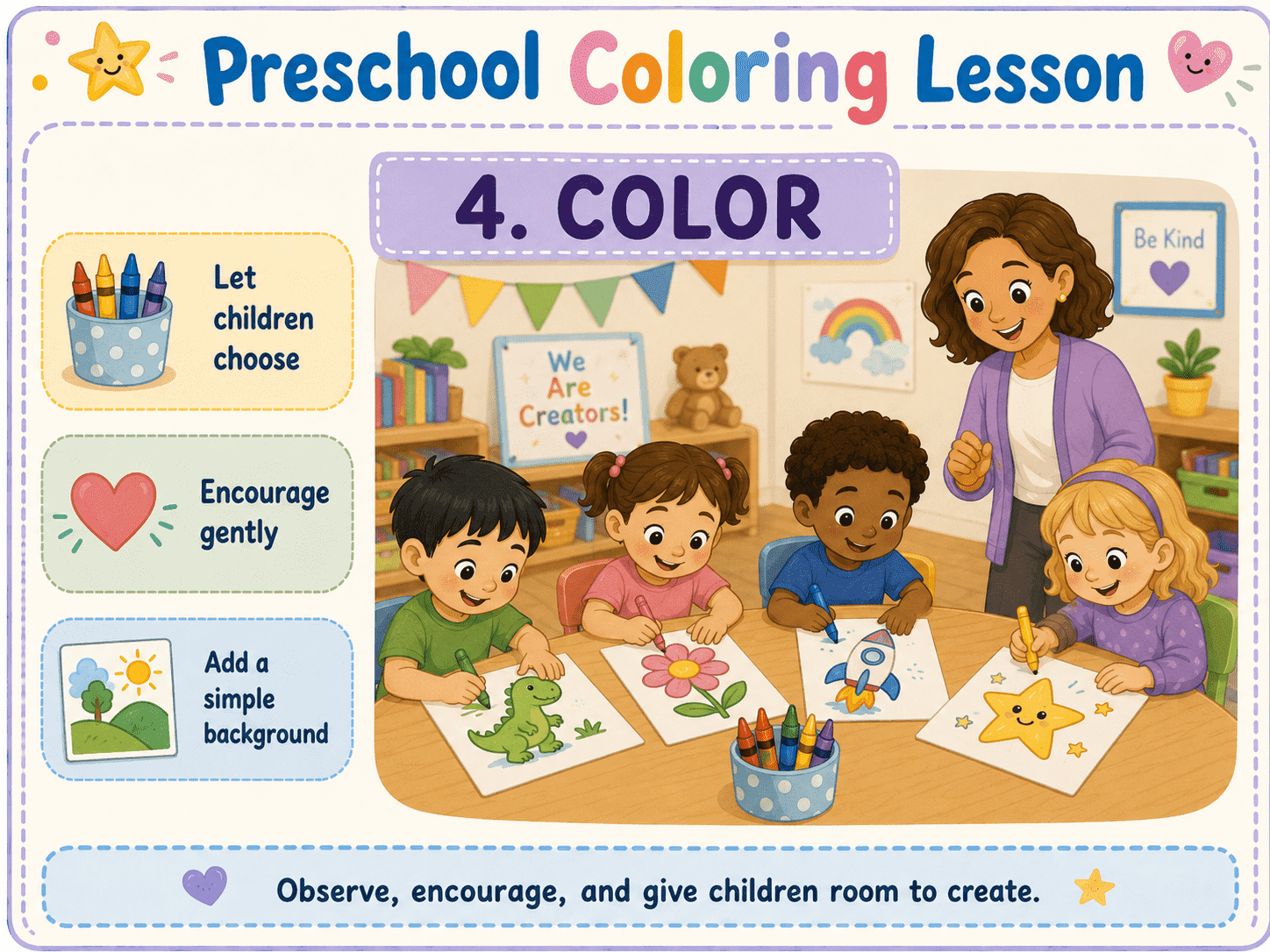
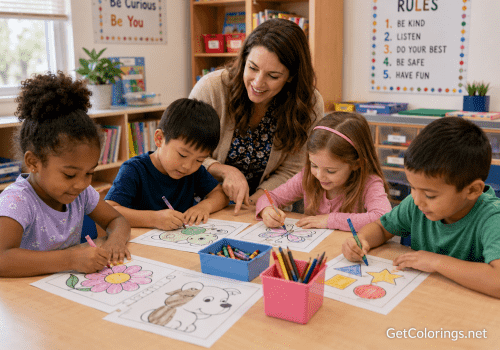
Now distribute the pages and materials.
During this part of the lesson, the teacher’s role is to observe, encourage, and ask occasional questions - not to direct every color choice.
Move around the room and use specific, positive comments:
“I noticed you chose two colors for the wings.”
“You are working carefully on that small part.”
“Tell me about the colors you picked.”
“You added something new to the background.”
Try not to say a picture is right, wrong, messy, or perfect.
If your lesson has a learning goal, include it gently. For example, during a number activity, ask the child to count the objects they colored. In an alphabet lesson, repeat the letter sound and the matching word.
Let children make their own creative choices. There is no need to correct a green sun or a purple cow unless the activity is about finding realistic colors.
Some children may finish quickly. Offer them one small extension:
“Can you add a background?”
“Can you draw two clouds?”
“Can you give your animal a name?”
“Can you add one more flower?”
Do not expect every child to finish the whole page. Preschoolers have different attention spans, and even an unfinished picture shows they took part.
Minute 20-25: Add a Short Learning Check
Instead of using a formal worksheet, check understanding through a quick conversation.
Ask each child or small group one question connected to the lesson.
For a color lesson:
“Which color did you use here?”
For a counting lesson:
“How many stars did you color?”
For a letter lesson:
“What sound does this letter make?”
For a vocabulary lesson:
“What is this part of the animal called?”
Children do not need to give perfect answers. Just repeat the correct word or idea in a natural way and let them keep going.
Teachers can find additional classroom uses for printable activities in How Teachers Can Use Printable Coloring Pages in the Classroom.
Minute 25-30: Share, Display, or Save
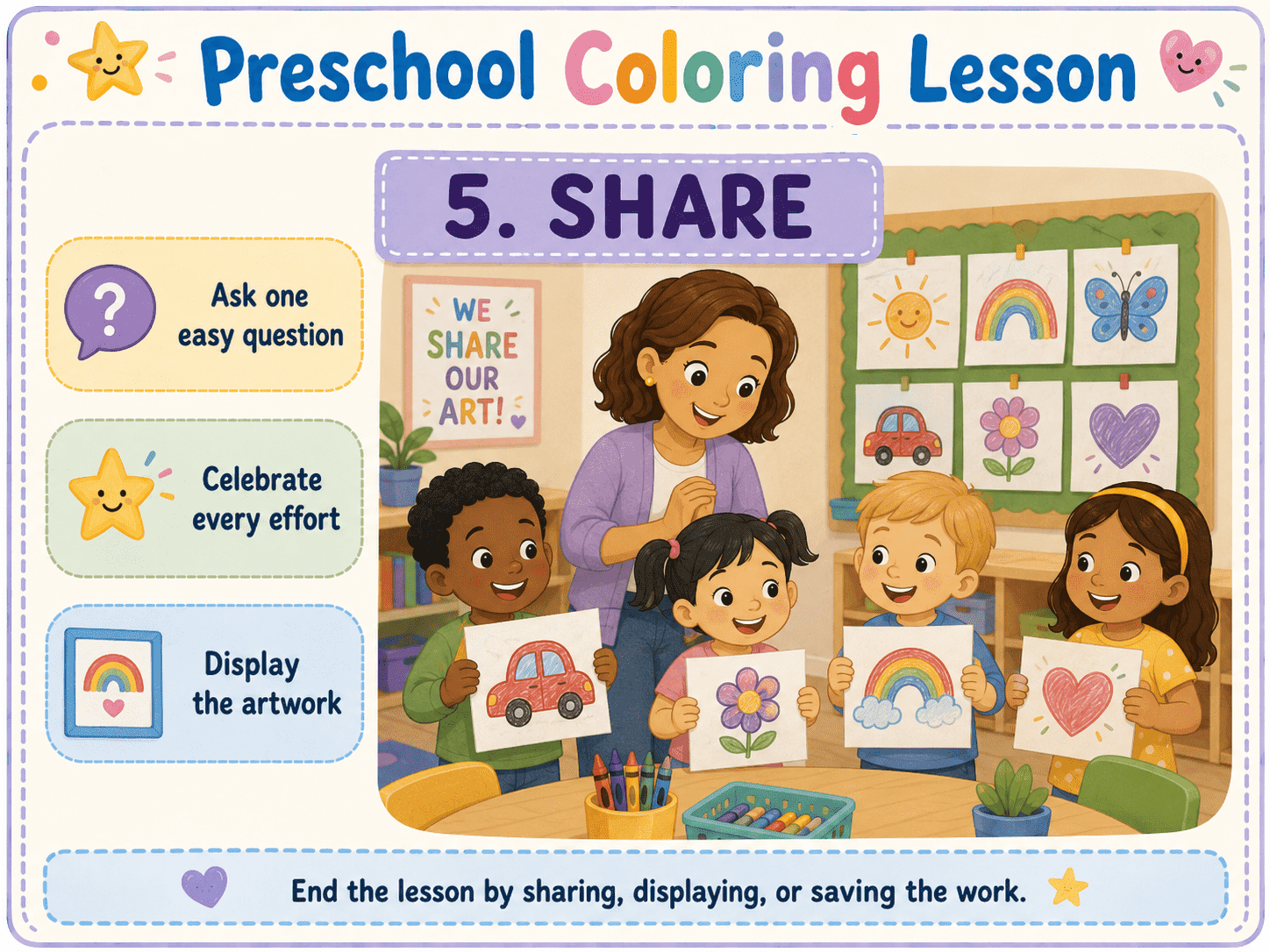
End the lesson by giving children a chance to talk about their work.
Invite a few volunteers to show their pages and complete a simple sentence:
“I used…”
“My favorite part is…”
“This picture shows…”
“I added…”
Do not force children to speak if they do not want to.
You can put finished pages on the classroom wall, send them home, or keep them in each child’s folder. Show work from different children, not just the neatest ones.
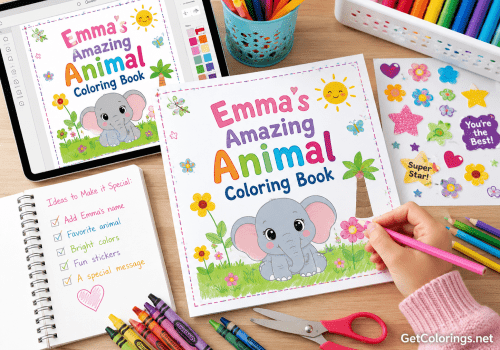
You can also combine several lessons into a classroom coloring book. Number pages, alphabet pages, animals, and seasonal pictures can be collected over time. The guide Turn Your Ideas into a Personalized Coloring Book can be adapted for a preschool class project.
Example Lesson: Colors and Butterflies
Here is one complete lesson you can use immediately.
Learning goal: Recognize four basic colors
Page: One large butterfly with thick outlines
Materials: Red, yellow, blue, and green crayons
Opening question: “What colors might we see on a butterfly?”
Teacher demonstration: Use short strokes to color one wing section
Main activity: Children choose colors for each part of the butterfly
Learning check: Ask each child to name one color they used
Extension: Add flowers, grass, or clouds around the butterfly
Closing sentence: “My butterfly has _____ wings.”
You can use this structure with many different themes.
A farm lesson might focus on animal names. A balloon page could teach counting. A large letter page can introduce alphabet sounds. 10 Fun Ways to Teach Numbers with Coloring Pages and How to Use Coloring Pages to Teach Letters and the Alphabet provide ready-made ideas for both topics.
What Makes the Lesson Successful?
A good preschool coloring lesson is not about how neat every page looks.
A successful lesson usually has four qualities:
- The children understand what they are doing.
- The page matches their age and ability.
- The learning goal appears naturally during the activity.
- The children have room to make their own choices.
If children join in, talk about the picture, try different colors, and practice the main idea, the activity has worked well.
Your Ready-to-Use Lesson Formula
For future coloring lessons, remember this simple sequence:
Set one goal, use one clear page, give a short demonstration, and allow lots of creative freedom.
Start by talking about the picture, let children color on their own, ask one simple learning question, and end by sharing or displaying their work.
This routine is simple enough to use all year and flexible enough for letters, numbers, animals, seasons, stories, and classroom themes.